

click to return to Writertopia home
Click to sign in

Browsing as a guest

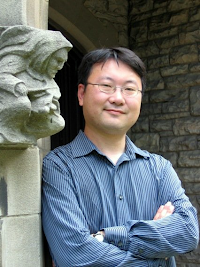
Tony Pi

Eligible for Campbell Award

More information


This profile moderated by
Tony Pi

Bio

Tony Pi has been fascinated by the printed word ever since early childhood when his grandfather operated a monstrous printing press out of the family home in Taipei, Taiwan. Immigrating to Canada at age eight with his family and not speaking a word of English, he armed himself with dictionaries in order to learn the language. Today, he holds a PhD in Linguistics from McGill University, teaching and researching dialects of Canadian English whenever opportunities arise. He is a 2006 winner in the L. Ron Hubbard's Writers of the Future Contest.

He currently resides in Toronto, Canada with his partner.

Bibliography

Short Stories

"The Stone Cipher", Writers of the Future Vol. XXIII, 2007.
"Metamorphoses in Amber", Abyss & Apex #24, 2007
"The Pinocchio Cantatas", Tales of the Unanticipated #28, 2007
"Zeno's Last Paradox", Abyss & Apex #16, 2005
"Dynamics of a Hanging", Shred of Evidence vol 3 no 2, 2005
"The Mirror King", Flash Me Magazine #9, July 2005
"He Immortal, Evergreen She", ON SPEC #62, vol 17 no 3, Fall 2005
"A Gorgon Comes for Hades' Helm", Aoife's Kiss #14, 2005

Poetry

"An Enchantment, With Apples", ON SPEC #60, vol 17 no 1, Spring 2005.
Forthcoming

Forthcoming

"Come Frost, Sun, and Vine", Tales of the Unanticipated #29, 2008.
"Aesop's Last Fable", ON SPEC, 2008 (TBD).
"Sphinx!", Ages of Wonder (DAW anthology), early 2009 (TBD).

Reviews

Publishers Weekly
"The Stone Cipher"

Fresh names worth watching include Tony Pi, who presents a chilling story of the world's end...

The Sci Fi Catholic
"The Stone Cipher"

Tony Pi's "The Stone Cipher" has a new and brilliant idea: all the statues in the world simultaneously begin speaking, and the story surrounds a linguist, Pierre, and his wife, Marie-Claire, who are trying to figure out what the statues are saying.

Baryon Online 106
"The Stone Cipher"

Imagine that all the statues started talking and it took half a day to say one syllable and the message was a warning; Tony Pi’s "The Stone Cipher" is a thought-provoking story.

The Fix Online (Audiobook Fix)
"The Stone Cipher"

Two stories really stood out to me. In "The Stone Cipher" by Tony Pi (read by Stefan Rudnicki), every stone statue in the word starts to speak, in unison, silently and very slowly. Once this is noticed, cameras are brought in so that the speech can be played at normal speed. Lipreaders translate, and ... it's a countdown. The story perhaps is a little highhanded in message, but the payoff is well worth the time. Rudnicki gives the story just the right ominous tone.

The Fix Online
"The Stone Cipher"

Tony Pi sums up the premise of “The Stone Cipher” with, “What if the whole history of human sculpture has been a conversation between the planet and humanity?” And what if one day, a careful observer discovers that the sculptures are speaking, albeit slowly, almost imperceptibly, but forming voiceless words nonetheless? Pierre and Marie-Claire are horrified to discover that the statues are counting down. Presenting dual religious views, Marie-Claire believes what is happening stems from the Roman-Catholic God, a message of doom or blessing; Pierre believes it’s a message from Gaia to humanity, a warning perhaps. The ideas and theories of what the countdown itself means play parallel with the theories of what will happen when the statues reach zero. The religious aspects are handled well, neutrally, and the story itself leaves the reader with a feeling of both damnation and potential hope.

Rich Horton, LOCUS Magazine
"The Stone Cipher"

Tony Pi's "The Stone Cipher" has one of the wildest ideas: statues around the world begin to move, apparently in unison, but very slowly.

L.A. Sorensen
"The Stone Cipher"

Another high point of this year’s anthology is Tony Pi’s “The Stone Cipher”. A modern-day sci-fi tale whose premise, that the stone statues of the world are trying to communicate with humankind, captivated me from the start and held me all the way through to its conclusion. The story is a must-read.

Rich Horton, LOCUS Magazine
"Metamorphoses in Amber"

A colorful and different adventure.

The Fix Online
"Metamorphoses in Amber"

Tony Pi has composed an elegant, multilayered tale in "Metamorphoses in Amber". Jewel thief Felix Lea is one of a small group of humans—the Elect, named after the Greek word for amber: electron—with the ability to tap into the lightning inside amber, shedding his body like a cicada sheds its shell. In the middle of waging his centuries-long war against nemesis Mantis, Felix contracts a debilitating disease, one which will ultimately change him from male to female. Only [with] the help of longtime friend and lover, Spider, and the aid of his hated enemy might he be able to halt a transformation that is not only permanent, but dreaded...The action in "Metamorphoses in Amber" never lets up, and the plot advances at a fast clip without sacrificing details. But the strongest feature of this work is the themes that Pi has interwoven; he touches upon gender, and what it means to be male or female, and what it means to stay true to yourself and your purpose while staying flexible enough to survive the fluctuations that occur with time...I really loved this story. The characterization and the descriptive language worked especially well.

SFRevu
"Metamorphoses in Amber"

The first story in the Table of Contents is "Metamorphoses in Amber" by Tony Pi. Felix Lea is by day an art dealer. He is also one of the Elect, people who can change their shape within certain limits by using amber with insects caught inside. After a night of stealing a Faberge Egg from his bitter rival, he realizes he is undergoing a metamorphosis that he does not want, The Widowing, in which a male Elect becomes a woman and cannot change back. He must go to his rival to stop the change. Pi creates an interesting culture here and details the science of the shape-changing to make quite a nice novelette.

Tangent Online
"Zeno's Last Paradox"

The other Zeno tale, Tony Pi’s “Zeno’s Last Paradox,” is the best piece of short fiction in the issue. Zeno himself narrates. Intending to rid the city of Elea from the rule of the Gorgon, whose eyes turn all to stone, he ends up falling in love with her and helping her with a quest of his own...You know it’s a rewrite of a Greek myth; you know it’s a variation on a Trickster tale, but Pi’s skillful twisting of mythic and Trickster tropes carry you along—especially when he sends the Gorgon on a heroic quest for her own mortality. I especially appreciate Pi’s characterization of the Gorgon as an intelligent, sympathetic riddler, worthy of Zeno’s respect, even love. “Paradox” reminds me of Ovid’s Metamorphoses—wry, grandiloquent, and intelligent. I wouldn’t be surprised if this tale ends up anthologized in a collection of modern myths; it’s a consummately crafted and entertaining gem.

Closed Beta

We’re invitation-only at this time for workshops, markets, and portfolio management.

Register

If you have an invitation, enter the code here:

Submit quick start code

Our Mission

Build collaborative web tools that help writers manage, improve, and publish their writing.

Kindle E-book Reader

Click to learn more